
The ESG Investment Paradox: When Doing Good Forgot to Do Well
Once hailed as finance’s moral revolution, ESG investing is now facing a credibility crisis. Performance gaps, capital outflows, and policy-driven strategies have eroded investor trust, proving that “doing good” doesn’t always mean “doing well.” Atlastic’s real-time Trust Intelligence bridges that divide, enabling investors to screen for ESG integrity, preserve alpha, and measure real-world impact. Because sustainable investing should reward performance and not just compliance.
The rise and stall of a $30 trillion Idea: A decade ago, ESG investing – allocating capital to companies performing strongly on Environmental, Social, and Governance dimensions – was hailed as finance’s moral awakening. Trillions poured into funds that promised a dual mandate: generate returns and drive responsible change. From Oslo to New York, pension funds and asset managers embraced the notion that sustainability was not only ethical – it was profitable. For years, that story held. ESG indexes outperformed, capital flooded in, and “impact” became a trading-floor buzzword. But somewhere between policy pressure, exclusion lists, and standardized ratings, the focus drifted. By 2025, the ESG boom looks less like a revolution – and more like a reckoning.
The Tide Turned Quietly
ESG investing began as a movement grounded in trust and purpose – the promise that doing good would also mean doing well. But in recent years, that link has weakened. The data now shows a growing disconnect: capital is fleeing ESG-labeled funds, and their performance increasingly trails conventional peers. The reason? Too many ESG strategies optimized for exclusions and compliance – not for alpha.
ESG vs. Non-ESG Fund Performance
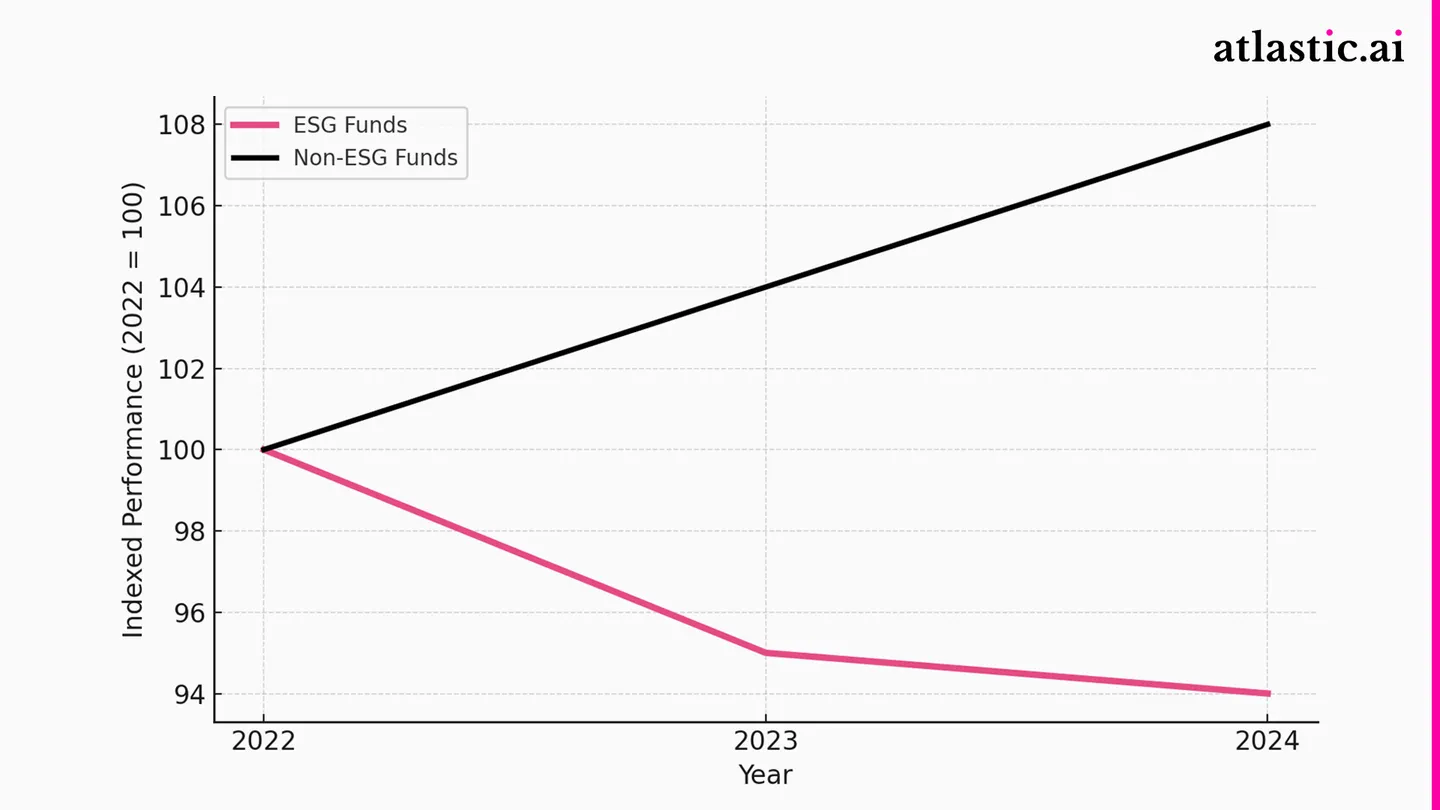
For the period 2022-2024, global ESG funds returned –2.4 % CAGR, while non-ESG peers grew +4.1 %. The gap opened sharply in 2022, when energy and defense sectors – often excluded from ESG universes – became top performers (Source: Morgan Stanley Research; Morningstar Global Sustainable Funds Report 2024)
According to Morningstar and the Financial Times, sustainable funds have faced seven consecutive quarters of net outflows – culminating in a record USD 19.6 billion withdrawn in Q1 2025. Many asset managers have quietly renamed or merged ESG strategies to avoid scrutiny, marking the end of an era when “ESG” alone attracted inflows.
Capital Flows Turning Negative (2023–2025)
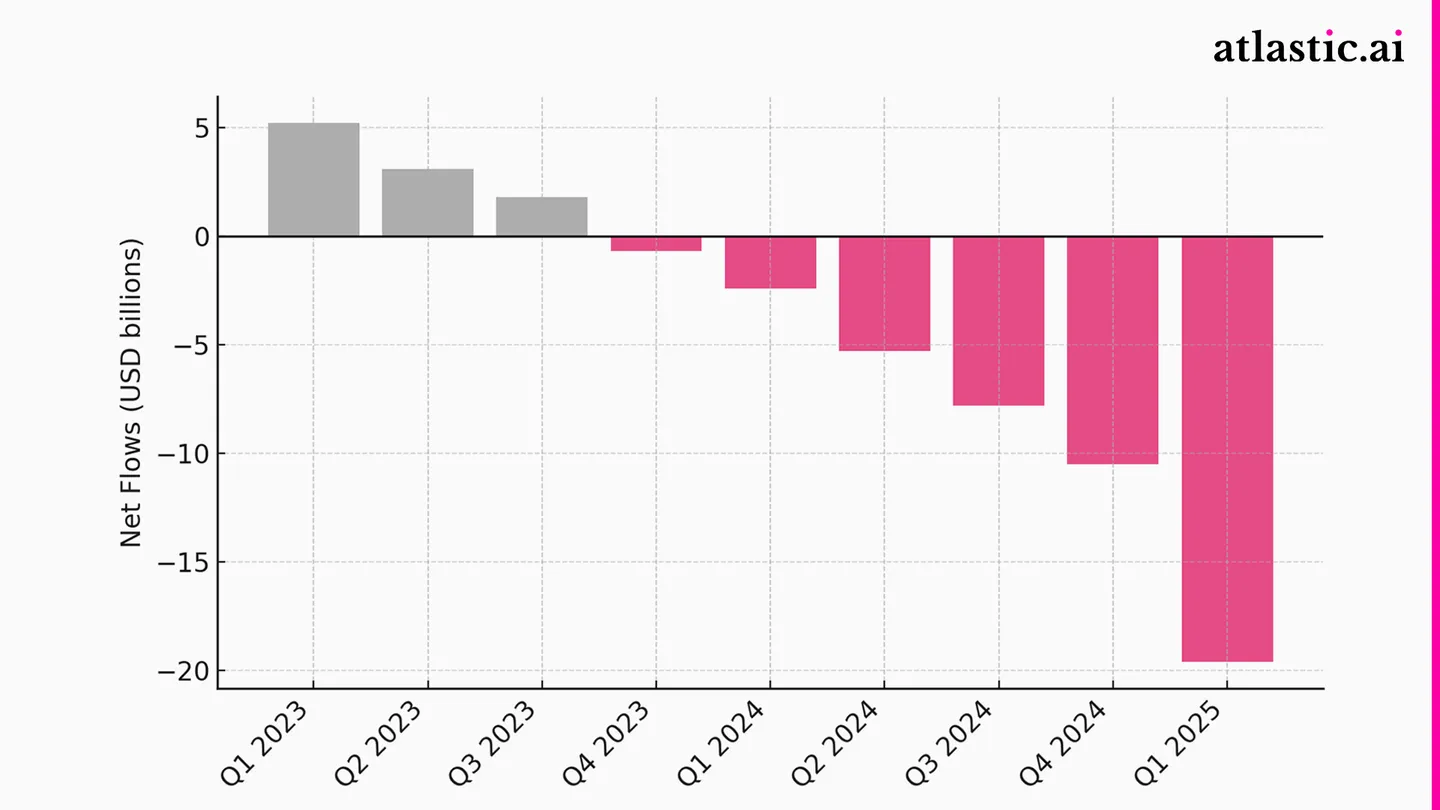
The trend is unmistakable: ESG is no longer a guaranteed magnet for capital. Investors now demand performance proof, not policy proof.
The Global ESG Landscape: Scale and Concentration
Despite headwinds, ESG remains one of the largest financial phenomena of our time. The global ESG investing market reached roughly USD 25 trillion in 2023 and is forecast to exceed USD 79 trillion by 2030 – a compound annual growth rate near 19 %. Europe remains the clear leader, representing ~84–85 % of global sustainable fund assets. Its dominance is driven by EU regulations such as the Sustainable Finance Disclosure Regulation (SFDR), mandatory ESG reporting, and strong demand from pension and sovereign funds.
United States / North America accounts for ~10 % of global ESG fund assets, far smaller in relative share but large in absolute value. Political polarization and shifting state-level policies have slowed new inflows, even as major managers like BlackRock, State Street, and Vanguard continue to offer ESG-linked products.
Asia-Pacific and Emerging Markets make up the remaining ~5 %, but show the fastest growth – driven by Japan, Australia, and South Korea, where institutional mandates and disclosure standards are expanding rapidly.
The Titans of ESG: Largest Funds by AUM
Even as smaller ESG vehicles shrink, the giants still dominate the narrative:
- iShares ESG Aware MSCI USA ETF (ESGU) – ≈ USD 25 billion AUM (BlackRock)
- Parnassus Core Equity Fund – ≈ USD 26.8 billion AUM (Parnassus Investments)
- ACS World ESG Insights Equity Fund (BlackRock) – ≈ USD 13 billion AUM
Together, the 50 largest sustainable funds manage roughly USD 224 billion, about 13 % of total ESG equity AUM. These “ESG blue chips” built the sustainable-investing narrative – yet now stand at its crossroads: scale without sustained alpha. (Sources: Morningstar; MSCI; SustainableInvest. Bloomberg Intelligence (2024–2025))
Why It Happened
The intention was right – but the incentives went wrong. Most ESG funds:
- Screen out volatile or controversial sectors, removing key sources of momentum.
- Cluster around similar large-cap “safe names,” reducing differentiation.
- Reward messaging over execution.
When sustainability becomes a checkbox, trust turns into a slogan – and alpha disappears.
The Atlastic Advantage: From Compliance to Performance
At Atlastic, we believe sustainability and alpha should reinforce each other – not compete. Our technology transforms global media, regulatory, and public-trust data into quant-ready signals that enable investors to:
| Objective | How Atlastic Delivers | Why It Matters |
|---|---|---|
| Screen for ESG Integrity | Detect controversies, governance red flags, and regulatory risks in real time | Strengthen compliance beyond manual ratings |
| Preserve Alpha Exposure | Identify sectors or issuers unfairly penalized by ESG overreach | Retain return potential under ESG constraints |
| Monitor Trust Momentum | Measure reputation shifts before they appear in traditional data | Turn trust drift into a predictive signal |
| Quantify Real-World Outcomes | Link narrative credibility to actual performance | Proves that authentic sustainability drives returns |
Meet ESG standards AND capture alpha
ESG was built on the belief that markets reward responsibility. That remains true – but only when responsibility drives results. The next generation of sustainable investing will measure outcomes, not optics. With Atlastic, investors can meet ESG standards and capture alpha – powered by real-time trust intelligence.
Thanks for reading. We’ll be back soon with more curated insights. In the meantime, you can explore the full live dataset at atlastic.ai for deeper analysis and real-time trust metrics.
Atlastic Signals delivers short, high-frequency updates on how companies and markets are perceived in the global media landscape.
Powered by millions of articles in 100+ languages and enriched by proprietary AI models, we surface what the world believes – before it hits the market.
Built for investors, analysts, consultants, and decision-makers who understand that perception drives performance.